Showing posts with label True crime. Show all posts

Friday, January 6, 2017

A Short Primer on Our Spring '17 Books


While we may not even be halfway through the winter yet, who said we can’t talk about our Spring ’17 catalog? Here’s a short primer on but a few of the exciting books we’ll be publishing in the months ahead:


1. Maximum Harm: The Tsarnaev Brothers, the FBI, and the Road to the Marathon Bombing by Michele R. McPhee (April)

McPhee’s brilliant investigative reporting uncovers explosive, previously unknown facts about the Boston Marathon bombing — secrets kept from the public that will make you wonder if justice was really served. Seriously. Don’t miss this book.


2. Vulture: The Private Life of an Unloved Bird by Katie Fallon (March)

Yes, vultures eat carrion, and yes, they do happen to occasionally vomit on their enemies. But this heartfelt, lyrical, and moving book just might be a PR coup for these much-maligned — and ecologically essential! — scavenging birds.


3. The Decibel Diaries: A Journey through Rock in 50 Concerts by Carter Alan (April)

From Crosby, Stills, Nash & Young playing in the rain the night Nixon resigned, to Eddie Vedder smashing his guitar through the stage at the Boston Garden — until he fell into the hole — Carter was there. Which is another way of describing how this vivid chronicle of rock ‘n roll will give you a backstage pass to music history.


4. The Lives of Dillon Ripley: Natural Scientist, Wartime Spy, and Pioneering Leader of the Smithsonian Institution by Roger D. Stone (June)

Whether he has documenting the bird life of India, running spies out of Ceylon for the Office of Strategic Services (a.k.a. the forerunner of the modern CIA), or leading the Smithsonian’s transformation from “the nation’s attic” to a hugely important cultural institution, S. Dillon Ripley was a man of inspiring abilities. They don’t make renaissance men like this anymore.
5. Buying Time: Environmental Collapse and the Future of Energy by Kaz Makabe (March)

In Buying Time, Makabe — a veteran financial systems expert who lived through the Fukushima Daiichi nuclear disaster — brings sharp, engaging reasoning to bear on perhaps the single most important question of our time: what is the future of energy? His exceptionally well-argued conclusions might surprise you.


6. Seven Million: A Cop, a Priest, a Soldier for the IRA, and the Still-Unsolved Rochester Brink’s Heist by Gary Craig (May)

From Ireland’s Long Kesh prison to the illegal poker rooms of Manhattan to the cold lakeshore on the Canadian border where the body arts began washing up, veteran journalist Craig’s detailed re-creation of a complicated heist executed by an unsavory crew of crooks will leave you riveted. The big unanswered question: Where are the missing millions?

7. Senator Leahy: A Life in Scenes by Philip Baruth (May)

This focused biography of America’s most senior senator chronicles critical moments in Patrick Leahy’s influential career, from the battle over the Patriot Act to the 2001 anthrax attacks to the opening of relations with Cuba to his role as a tough-talking extra in the Dark Knight trilogy of Batman films. The only book of its kind.

8. Hot Hands, Draft Hype, and DiMaggio’s Streak: Debunking America’s Favorite Sports Myths by Sheldon Hirsch (May)

Sportswriter Sheldon Hirsch looks at myths, legends, conventional wisdom, shibboleths, and firm convictions of all kinds that sports lovers hold to be true, and demonstrates how analysis of facts and figures disproves what tradition would have us believe. What if everything you thought you knew about baseball, basketball, and football is, well, wrong?


Click here to check out our full Spring '17 catalog. Happy reading!

Thursday, October 6, 2016

Poison, Prison, and Pennsylvania Courts: How a Veteran Reporter Dove Deep into a Fascinating Murder


By Paula Reed Ward,

Throughout my 20-year career as a police and courts reporter, I have covered every kind of case imaginable. But the death of Autumn Klein by cyanide in 2013 was my very first poisoning.

The story itself — a 41-year-old neurologist allegedly killed by her husband — was fascinating. Add to it that she was killed by poison, which almost wasn't detected, and it became unforgettable.

But then I learned about who Autumn was. The kind of doctor. Mother. Friend. I knew that I couldn't let the case go by without writing a book about it. I wanted to make sure the world didn't forget her. 

Doing the reporting and research for the book was all-engrossing. I spent months tracking down Autumn's college roommates and classmates. I read medical journals to learn about her specialties. I talked to her colleagues and professors. And to her family. 

That must have been the best — and most difficult — part. Autumn's cousin and best friend, Sharon, spent countless hours with me on the phone, sharing the cherished stories of their childhood. Then she spent hours more with me in person. 

Autumn's mother Lois, too, spent nearly six hours with me. She told about her daughter — the kind of child she was and the kind of woman she blossomed into. She also told me about her own relationship with Autumn's husband, Bob Ferrante. She didn't like the idea of her daughter marrying a man 23 years older, but she would also never get in the way of true love. It wasn't her decision to make, Lois said. As we talked that day — and as Lois showed me photographs taken throughout Autumn's life — I couldn't help but feel a deep sadness for her and her husband, Bill. But this sadness also gave me the resolve to know that writing a book about their daughter was the right thing to do. 

Then there was the challenge of getting Bob's side of the story. Although I knew all along that my main purpose for the book was telling the world about Autumn, it was essential — to me — to be fair, and represent both sides. As a newspaper reporter, my career has been spent trying my best to be impartial. That wasn't going to change here. 

So, I set out to get Bob to talk to me. By that point, of course, he was in our local jail (and later, state prison). I sent him a letter. I contacted his attorney. Over weeks of discussions, they finally permitted me to send Bob written questions. I did. And he sent me pages and pages of written answers back. It was a gold mine of detail — about his and Autumn's relationship. His childhood. Raising his two adult children from his first marriage. And how much he missed the young daughter he and Autumn had. 

I also spoke with him twice by phone from prison. During our interviews, I didn’t ask Bob tough questions, like “did you do it?” or “why would you do those Google searches?” I knew I wouldn't have some Perry Mason moment where he shouted, “You got me! I did it.” He denied committing the crime at trial; I wasn't going to trick him into confessing. So, what was most important to me was trying to tell Bob's story — just like I was telling Autumn's. I wanted to know about his life, his family, his education and career. And about prison. 

He shared those things with me. And I included them all. 

Bob recently lost his first round of appeals and will soon file with the Pennsylvania Superior Court. It will be interesting to see how it all plays out. 

In the meantime, I will keep covering the case and the people involved. And keep writing the stories that come through the courthouse each day. Like I always have, I will strive to make sure that everyone's side gets told, and that every story is representative of the person it was written about. 

Tuesday, September 25, 2012

A Murder in Wellesley: New book revisits Greineder case

Originally posted 9 24, 2012
by BBrown for Swellesley Report


A new book about the gruesome Halloween morning murder of Wellesley’s Mabel Greineder by her husband Dirk at Morses Pond is about to debut. Not coincidentally, the authors will be visiting Wellesley next month to promote their account, almost exactly 13 years after the killing.

A Murder in Wellesley: The Inside Story of an Ivy-League Doctor’s Double Life, His Slain Wife, and the Trial That Gripped the Nation is written by Boston Herald reporter-turned-PR guy Tom Farmer and Marty Foley, who was the lead state police detective on the Greineder case.  The book promises “the untold story” and includes information from those who previously have declined to speak publicly about this case that “bitterly divided” the Greineders’ family. These sources include the Greineders’ niece, Belinda Markel, who testified against Dirk Greineder, as well as Greineder’s college roommates and crime scene investigators.


The case gained national prominence in the early 2000s as salacious details of allergist Greineder’s secret life of porn and prostitutes, against the backdrop of our “well-heeled” community, aired nationally on Court TV. Numerous TV, magazine and newspaper reports rehashed the story, including an A&E documentary program called City Confidential.

Greineder, now in his early 70s, was sentenced to life in prison for murder in 2001 and he has repeatedly sought to appeal the decision. The state Supreme Judicial Court will hear more arguments in November. Farmer declined to speculate on Greineder’s chances of getting a new trial, saying we’ll have to see what the SJC does.

Read the rest of the story

Friday, August 31, 2012

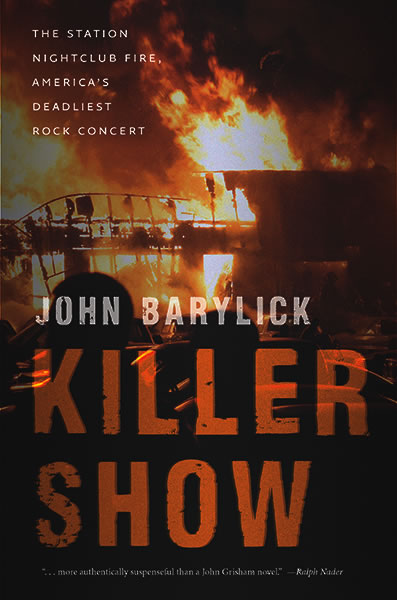
Devastation, Tragedy, Truth, Memorial - KILLER SHOW Reviewed

By Victoria Eagan


I am a survivor of the Station fire. I have worked extensively with family members and fellow survivors for the past 9 1/2 years in fundraising and offering financial and emotional support. With that being said, I truly felt as though I knew all there was to know about the fire as well as the people it affected. I have lived and breathed it since the very first night. I was wrong. I have been asked countless times to talk about that night and tell people what "really happened". I now intend to point them toward this book.

It is a comprehensive and educational account of the facts surrounding the fire and the aftermath. You could read hundreds of newspaper articles (and there are certainly hundreds) that would not give you the concise and accurate information found here.

I applaud John Barylick and his fellow attorneys for this daunting undertaking and the hard work they put in in order to bring some sense of comfort to those affected. Attorneys are often vilified for "taking advantage" of a situation. Those involved in this case (the majority) did it for the right reasons. Without their perseverance and tenacity, so many of the victims' families and survivors would have added financial decimation to their already devastating emotional and physical losses.

I encourage you to educate yourself by reading this book. Remember the loss of life and those who will live with the physical and emotional scars forever. Remember what happened, and honor those lost, by helping to make sure it never happens again. 

Killer Show: The Station Nightclub Fire, America's Deadliest Rock Concert is the first comprehensive exploration of the chain of events leading up to the fire, the conflagration itself, and the painstaking search for evidence to hold the guilty to account and obtain justice for the victims. 

For seven years John Barylick was a lead attorney investigating and prosecuting wrongful-death and personal-injury cases arising from The Station fire. He has practiced law in Rhode Island since 1977.