Showing posts with label ForeEdge. Show all posts

Friday, June 10, 2016

In Search of the Soviet Spies with Two Lives


The subject of my book, Operation Whisper, came to me on a morning that seemed to have been modeled from childhood memories, moist and green, smelling of jasmine and wild onions. I was sitting under the big oak in my backyard in New Orleans, drinking coffee and searching the paper for something interesting. But it was a slow news day. I was about to move on to the sports section when I noticed a story buried at the bottom of an inside page.

A famous spy for the Soviets had died in a KGB nursing home in Moscow. His name was Morris Cohen, eighty-four years old, born in the Bronx. There was something odd about this. I knew that Americans had spied for the Russians, but how many had actually got on a plane and defected to the workers’ paradise?

And just how famous was he? The story went on to say that Morris and his wife Lona had run a Soviet spy network in the United States and Canada during World War II. They stole atomic secrets from the Manhattan Project and put Russia on a fast track to building its own nuclear arsenal. The Cohens, and not the Rosenbergs, had delivered a complete diagram of the first A-bomb to Moscow. That, I had to admit, was an impressive set of bona fides, as they say in the trade.

The story also said that Morris had worked as a sports writer for the Memphis Press-Scimitar before the war. That’s when I sat up. I had worked as a reporter for the Press-Scimitar. It was my first major-market journalism job. A Russian spy was an alumnus of the Press-Scimitar? I put the paper down. Was that why some people used to call us Reds on the Press-Scimitar? I poured another cup and read on.

Morris had served in an international brigade in Spain and fought against Franco’s army, the obituary said. He was wounded in battle and recruited for spying while recuperating in a hospital. I put the paper down. The Cohens sounded like a good subject for a feature story or an essay in a historical journal.

I obtained a copy of their FBI file, which included interviews with people who had known them in America at different times in their lives. I began mining sources at libraries, archives, museums, and additional government offices. I found that the Cohens, after leaving America, went on to atomic spying in England. But when I started checking British sources, I hit a wall. Nobody had ever heard of the Cohens. What was I doing wrong? My course was finally corrected by a helpful soul in the morgue (library) of the Sunday Times.

“Who?” he said.
 
“Morris and Lona Cohen,” I replied.

“Famous spies for the Soviets.”

“In Britain? Never heard of them.”

“It was the Portland spy case.”

“Oh! You mean Peter and Helen Kroger. Bloody Yanks.”

Things really opened up after that. I collected British news stories about the Cohens, and memoirs and reminiscences written by the spies they worked with, and the spy catchers who caught them. I contacted people who had known them, and located some good published interviews, including one conducted by KGB historians.

The Cohens and their London spy ring were finally captured in a joint effort by the FBI, CIA, RCMP, MI5, and Scotland Yard. When I found that out, I knew there was a book in all this. The roll-up was called Operation Whisper. The case featured all the elements of a Hitchcock thriller: chases, blackmail, threats of assassination, secret drops, secret meets, secret knocks, secret codes. Nocturnal beach landings and shots in the dark were included, along with a double-agent femme fatale. The Scotland Yard detective who arrested them was called Moonraker. I especially liked that.

One thing I noticed early on was that Americans who had written about the Cohens offered little information about their later work as the Krogers in England. And British writers who wrote about the Krogers seemed to care little about their previous incarnations as Americans. Thus, in my book I have tried to bring together a narrative history of the Cohens’ “two lives” on both sides of the Atlantic.

Equally, I’ve described how police and security agents in the United States, Canada, and Britain systematically tracked down the Cohens, clue by clue. Writers often concentrate on the political ideology of spy cases and ignore the work of the spy catchers. But in a chase, I think the role of the hound is just as thrilling as that of the hare.

In the course of my research I learned a lot about spying, about the Spanish Civil War, the two world wars, and some truly fascinating characters I would like to have had a drink with. At times, the well ran dry. Other times, there was a flood. That’s why I like research. But most of all, I like the writing.

I don’t agree with what the Cohens did. But I do think they led intriguing lives. I’ve always believed that contradictions in character are the things that make people interesting. You’ll find plenty of those in Operation Whisper.


Thursday, May 5, 2016

10 Simple Solutions to Better Hand Hygiene


Did you know today, May 5th, is World Hand Hygiene Day?

The World Health Organization (WHO) is the force behind an awareness campaign to make sure we're all practicing responsible hand hygiene. It just so happens that this week, through our ForeEdge imprint, we've also released The Hand Book: Surviving in a Germ-Filled World, by Miryam Z. Wahrman—yes, a handbook to understanding the critical importance of maintaining clean hands in your daily life, with advice on best hand hygiene practices.

So what better time to share some of Wahrman's helpful tips? And some may seem like common sense, but often the most obvious are the easiest habits to break. Here are ten things you can and should be doing to keep those hands clean and yourself and others germ-free:

1. Don’t shake hands, do the fist bump. If you do shake hands, be sure to wash up or use alcohol-based hand rub before touching your face or eating.

2. Keep your washing-up areas stocked with plenty of soap and clean cloth towels or paper towels. This is equally as important at home as it is at work.


3. Always keep a bottle of alcohol-based hand rub handy, at work or on the road.

4. If you are a parent of small children, or a caretaker for a family member, keep your charge’s hands clean.

5. Teach your children from the earliest ages to keep their hands clean, in particular, to wash after coming home from school, the playground, or other activities, and before eating.

6. If you are a supervisor at work, develop and encourage hygiene policies for your employees. Your initiative may be as modest or subtle as making sure there is soap and paper towels in the bathrooms and hand rub available in the office.

7. If you work in health care, be vigilant about hand hygiene, cooperate with hygiene policies, and take the initiative to be a role model for others.


8. According to the WHO, 61% of health workers do not clean their hands at right moment. So if you are a patient, politely ask your health worker to wash hands and don gloves. If you are advocating for a family member who is being treated, you should do the same. This is not the time to be bashful or worry about insulting someone.

9. If possible, when buying prepared food, be aware of how your food is handled and ask the food handler to wash hands or don gloves.

10. Learn about local health codes, and advocate for them. Encourage your legislators to develop policies, codes, and laws to further protect consumers.

For more information about World Hand Hygiene Day and how you can spread the word (not the germs), visit the WHO's website.

And to learn even more, including how ancient cultures dealt with disease and hygiene and how scientific developments led to the germ theory, pick up Miryam Wahrman's The Hand Book: Surviving a Germ-Filled World, available now!


Tuesday, May 3, 2016

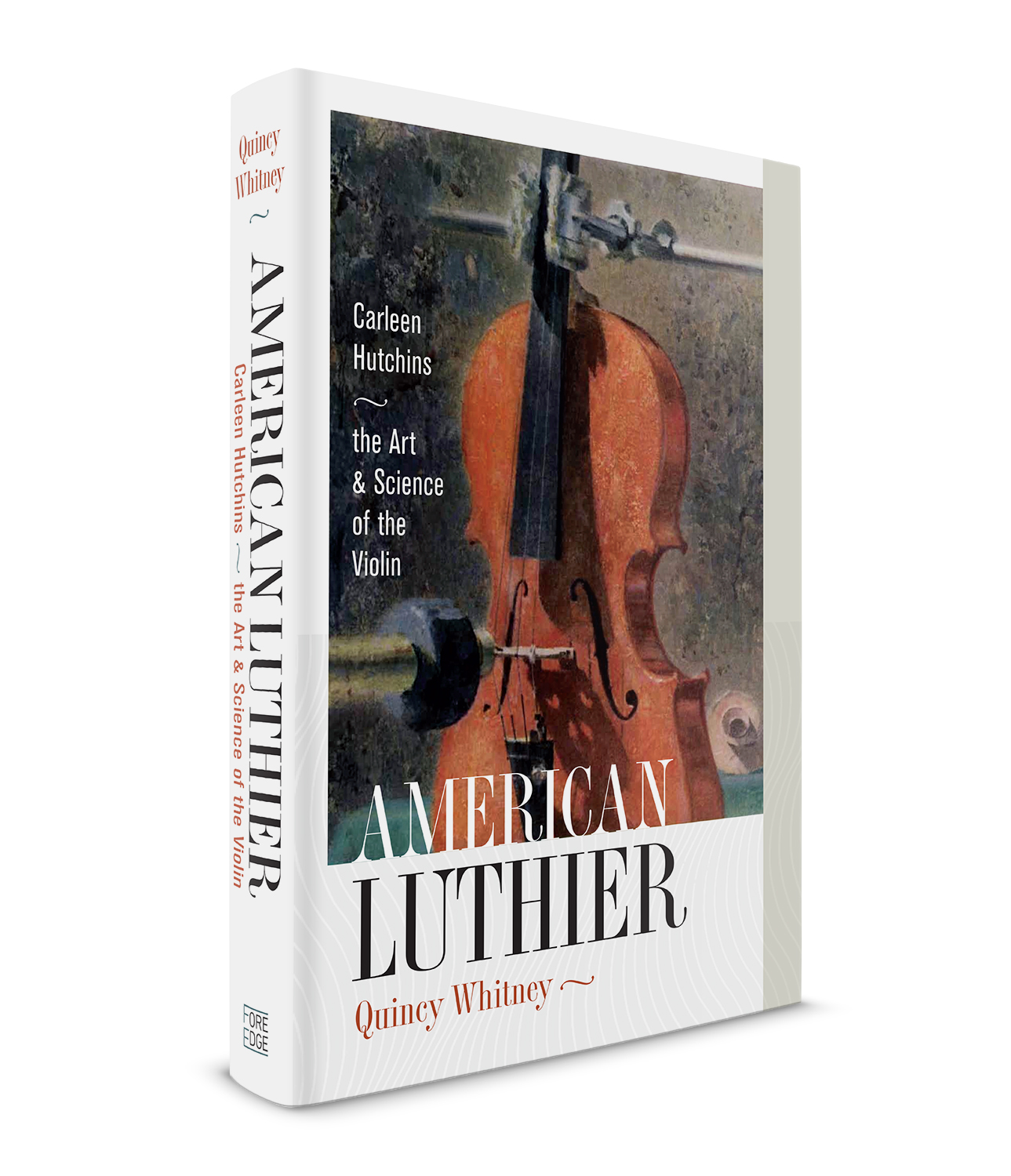
An American Woman in the City of Violins

Carleen Hutchins measuring the thickness of a violin plate, ca. 1960. Images courtesy of Hutchins estate.

by Quincy Whitney
author of American Luthier: Carleen Hutchins—the Art & Science of the Violin

Cremona, Italy, October 1997. Standing in Piazza Lodi, I felt a ­mixture of excitement and frustration at the realization that my husband Eli and I had clearly reached a dead-end. We had veered off the beaten path of an itinerary we had planned for an anniversary trip to Italy in order to take in the City of Violins, at the suggestion of Carleen Hutchins, whom I had met just a month before. We were now evidently quite lost.

I met Carleen because of a stranger sitting next to me at the New Hampshire Humanities Council annual dinner who, upon hearing that I was a Boston Globe arts reporter covering New Hampshire, said I should contact a violinmaker who summered up on Lake Winnipesaukee. Nevertheless, when I took up her lead, the most significant interview I ever conducted was almost the fish that got away. When I phoned Hutchins to ask for an interview, she turned me down flat. In fourteen years, I had never come across an artist, educator, historian, or scholar who did not want free publicity. I soon discovered that Carleen Hutchins seldom did the predictable thing. Taken aback by her refusal, I hung on the phone, contemplating my next move. Suddenly, Hutchins blurted out: “What’s your angle?” No one had ever asked me about “my angle” before. With no time for a clever comeback, the first thing that came to mind was the truth—I told her I was fascinated by stories where science and art overlap. Bingo. The door opened. “That’s exactly what I do,” Hutchins said. “When do we talk?”

Two weeks after my feature appeared in the Globe in August 1997, Hutchins phoned to ask if I would consider writing her biography. Tired of weekly deadlines and intrigued by the idea of a larger project, I still wondered if everything she had told me could possibly be true, as her story seemed too remarkable to be real. Just a month later in October 1997, a serendipitous trip to Italy cast away all doubt. When Hutchins found out that my husband and I were going to Italy, she asked if we would mind visiting Cremona, “City of Violins” and the birthplace of Antonio Stradivari, as she was bent on tracking down an old friend who had moved his workshop—Maestro Francesco Bissolotti. “Bisso,” as Carleen called him, was one of two master luthiers who in 1937 had founded the city’s prestigious violinmaking school in honor of the two hundredth anniversary of Stradivari’s death. Hutchins wanted to send him Research Papers in Violin Acoustics 1975–1993, the definitive collection she had just finished editing.

Now here we stood in Piazza Lodi. After hiking up the stairs to Bisso’s abandoned workshop, which held no clue as to a forwarding address, we had reached an impasse. As we sat in our rental car, ready to pull away, two students crossed the piazza, one carrying what looked to be a violin case. I approached the student who had stopped at a pay phone on the edge of the piazza, and in my struggling Italian, I said, “Bissolotti.”

“Bisso?” he said suddenly in broken English as he hung up the phone. “We have never met Maestro Bissolotti, but we have come to Cremona today to buy a viola!” The four of us meandered down a cobblestone street as if feeling our way in the dark, until two Japanese gentlemen appeared out of nowhere, asking, “Bisso?” We followed them to an archway leading to a small courtyard, through an open wrought iron gate, into a smaller courtyard, where we found ourselves pulling the knocker on an old door covered with peeling green paint.

We were ushered into the outer room of the workshop of “Bisso,” a short man with a mustache and winning smile, who immediately began speaking Italian to the student bent on purchasing a viola. Bisso knew not a word of English, but when I presented a letter signed by Hutchins, his face lit up. He motioned for one of his apprentices, Lorenzo Cassi, to accompany us on a tour of the Palazzo Comunale. When I asked Lorenzo if he knew of Hutchins, he replied: “I have never met her, but we have read every paper she has ever written!”
Carleen Hutchins, ca. 1990.

To find the Collezione Civica in the Palazzo Comunale, one need only look for the tall bell tower in the heart of Cremona. Inside the galleries, glass display cases house the earliest known violin, made in 1566 by Andrea Amati—the undisputed father of the violin—along with a 1615 viola made by Amati’s son Girolamo, a 1689 Giuseppe Guarneri violin, and a 1715 Stradivarius violin. On the day we visited, in the corridor just outside the violin galleries, we passed From Tree to Violin, a month-long exhibition created by the violinmaking school. Had we visited two weeks later, we would have missed it. The very last exhibit panel was devoted to Carleen Maley Hutchins.

Here in the City of Violins, keeping company with the most celebrated names in the violin world—all of them Italian men—was a living American female violinmaker, a woman who had taught herself acoustics by carving violins. I was immediately intrigued. Why had I never heard of this female luthier who had asked me to tell her story? In the midst of our conversations, Hutchins would get phone calls from luthiers in Australia or China, physicists and museum curators in England and Scotland, a dendro­chronologist in Paris, a luthier in Belgium, members of the St. Petersburg Philharmonic in Russia, a conductor in California, a faculty member at Juilliard. It became clear Hutchins had developed an international community around violin acoustics and she had created a new family of violins—yet she seemed to be a hidden treasure.


The preceding is excerpted from the introduction in American Luthier.

Friday, January 22, 2016

Why the Grateful Dead Will Always Matter

Grateful Dead at the Warfield Theatre in San Francisco, Oct. 9, 1980. Photo by Chris Stone.

Last summer, after fifty years, the band with which the tie-dye shirt became synonymous, the group that helped to define an era (or certainly its vibe), the Grateful Dead performed a series of shows as a whole group (with Jerry smiling down in the form of a rainbow) for the last time. But like many of the concert-goers who couldn't bring themselves to leave after the final notes of the final "Fare Thee Well," the Dead won't soon fade from time or memory. In 2016, an offshoot of the band, called Dead & Company, is expected to tour, and a Dead tribute album seems to be in the works. And just released from ForeEdge, a lovesong to all things Dead, titled Why the Grateful Dead Matter, by Michael Benson, dives deep—as deep as any Dead guitar riff—into this timeless band's enduring legacy. Here’s a taste. 


by Michael Benson
author of Why the Grateful Dead Matter

Light the song, and pass it around. Don’t bogart. Let it shine, let it shine, stoke it on a Palo Alto stage, until that fire reaches the mountain in Concord, the magnolia fields down by the river, becomes a conflagration of the heart stretched from South Colorado to the West Texas town of El Paso, the twilight purple plain of Wichita, all the way to Europe and the Pyramids of Egypt under a lunar eclipse. Stoke it until it envelops the Earth with an accelerando of Peace.

And that’s the Grateful Dead, not just a band that played songs, sold records, and gave concerts, but a band of sorcerers, conjurers of a rare and different tune, music with a heartbeat and breath, with the perfect tension between dissonance and resonance, suspension and completion, a cynosure for the huddled masses, tie-dyed angel music for spinning the sacred dance of life as a falling leaf at the jubilee, a rolling away of the dew, a movement and groove that gets into the fiber of your skull, spreads like ripples on still water, grows roses along a trellis of bones, messes with the gears of your body clock until you’re on a long, strange pilgrimage jonesing to find the 45-minute Sugaree, waving that flag, driving that train, holding away the despair with a cloak of space and drums, lightening the load until you get up and fly away.

You don’t have to take my word for it. The famous mythologist Joseph Campbell (his book The Power of Myth is required reading in college sociology courses) went to a Dead show and said the music was the antidote to the Damoclean sword of nuclear war.

Jerry Garcia, performing with the Dead, May 10, 1980, in New Haven, CT.

Why does the Dead still matter? Why will they always matter? Sure, because of the genius music, years of trippy listening pleasure—Jerry Garcia’s beam-me-up-Scottie leads and achingly sad vocals, Phil Lesh’s intricate bass lines weaving in and out of everything including the sound system, Bobby Weir’s strong masculine vocals and truly weird and wonderful second-chair guitar, the growling blues of Pigpen, the musicality and lightness of Keith and Donna Godchaux, and the Apocalypse Now rhythm section, the devils, Bill Kreutzmann and Mickey Hart, all of whom we’ll be on a first name basis with from now on—but there’s a rebel bad boy social component as well. Their first fans thought they were bikers. The band matters because through it the counterculture lived on—ironic because the musicians were more piratical than political. They never turned a show into an anti-war demonstration. Although they were against all violence, their vision of show biz didn’t involve causes. They just didn’t like to follow rules and were constantly trying to get away with shit. But it didn’t matter. The counterculture burbled urgently from deep fissures in the earth beneath the San Andreas Fault and the Dead were swept away in the movement despite their apathy. They were too close to the crack to avoid the deep rifts in society.

America came out of World War II a militaristic animal, intoxicated by its own might, its ability to push enemies around, to purge the world of evil. But the following generation, the kids coming of age in the 1960s, saw military solutions in a different light. The war in Vietnam had no real purpose; it had sprung up like a malignant weed through the cracks in Dealey Plaza, Dallas, a crossfire disguised as a magic bullet that burned Camelot to the ground. While America was spoon-fed Oswald pabulum, an undigested buzz of coup cabal grew into an electronic feedback wail—Dylan at Newport—and radicalized the American folkie-bohemian.

Bob Weir, performing with the Dead, Dec. 31, 1976.
Anti-Nam protests evolved smoothly from the pre-existing Cold War academic beatnik movement to “Ban the Bomb.” Like the war before it in Korea, Vietnam was a Civil War, a North fighting a South, and there seemed no cause for the U.S. to intervene. What was it all about, anyway? Profit? They said it was about the “Domino Theory”: if North Vietnam—and it’s Red Chinese backers—were allowed to conquer South Vietnam, the other small countries of southeastern Asia would fall as well. To many, the theory seemed weak—who cared who owned the jungle? Eisenhower had warned of the military-industrial complex, which would one day come slouching toward Bethlehem. War without reason was a symptom of the behemoth. The younger generation believed that war existed only to make a few men rich, while sacrificing the lives of American boys who didn’t have the connections to avoid the draft.

American involvement in Vietnam was light until the so-called “Gulf of Tonkin” incident, in which it was reported that a North Vietnamese ship fired across the bow of an American ship, an act of aggression used by LBJ, sworn in on Air Force One on a terrible day in Dallas, as an excuse to escalate hostilities to the jangly tune of billions of dollars and more than 50,000 American lives.

Finally, CBS newsman Walter Cronkite, “The Most Trusted Man in America,” said on the six o’clock news that the war was unwinnable. In order to show their dissatisfaction with the world the adults were creating, the youth of America grew their hair long, a fashion that began as Beatles-esque but eventually became anti-military. Youths began to take mind-altering drugs, which they were told by Timothy Leary, Aldous Huxley, Ken Kesey and so many others, would expand their consciousness. Like Jack Kerouac and the beatniks before them, they worshipped the road, all the roads that led to the next Dead show, psychic roads that led to enlightenment.

It was the birth of a movement, initially a fad of psychedelia, from which the Dead were the last survivors.


This has been excerpted from Why the Grateful Dead Matter, by Michael Benson.


Friday, November 13, 2015

Watching the Debates? Here's How to Game the Presidential Election

It's like BINGO, but fundamentally better for the 21st century.


Now less than a year from the 2016 presidential election, the GOP candidates vying for the office still number more than a dozen, the Democrats have narrowed to three, and we've only scratched the surface on the calendar of debates—though there's been plenty of excitement so far.

Depending on your political bent, or even your level of tolerance for other candidates within your party of choice, sitting through a three-hour debate can be any combination of exasperating, inspiring, dispiriting, hilarious, at times educational.

Between all the competition to get a word in edgewise and the ding-dinging time limits on the candidates' statements and rebuttals, these performances too easily devolve into canned polemics, nifty soundbites, and the kind of political doublespeak that lets a politician say as much as possible without really saying a thing.

Authors David Mark and Chuck McCutcheon wrote the book on this very phenomenon. Dog Whistles, Walk-Backs, and Washington Handshakes collects dozens of examples of the jargon and blather of the players, both elected and those behind the news desk, who make a living out of  misguiding the electorate. (Check out our coverage last year on "How to Talk Like a Politician.")

So, there's no reason why you and your friends can't have a little fun at the expense of these smooth talkers.

In honor of the forthcoming release of the eBook, Doubletalk (on-sale February 2016), Mark and McCutcheon's election season supplement to their first book, we created BINGO cards (like the one you see at the top of this post)—six of them—which you should totally print out and put to good use, abiding by whatever house rules you invent (ahem), when the next debate is on.

(By the date of this post, the next one is the Democrats' turn: Sat., November 14, 9 pm EST, on CBS.)

Click on the following link to download PDFs of all 6 BINGO cards, and have fun. It's gonna be yuge:

Presidential LINGO Game (PDF)


Monday, November 9, 2015

The Inside Story of How Marc Solomon's WINNING MARRIAGE Won Big


by Tom Haushalter
UPNE Marketing Manager

“If I can sell gay marriage, I think I can sell a book.”

That was one of the first things Marc Solomon, author of Winning Marriage: The Inside Story of How Same-Sex Couples Took on the Politicians and Pundits—and Won, said to the UPNE sales and marketing team when we gathered for lunch in Boston several months before his book's November 2014 publication in our ForeEdge imprint. Although a debut author—of a chronicle of his life's work waging the then-unfinished legal battle for marriage equality in America—Marc came to lunch with questions about book promotion that seemed to be searching for parallels to the grueling public relations campaign he'd been directing (with Freedom to Marry) for years. In other words, this wasn't Marc's first time to the rodeo.

We were all keenly aware of the possibilities surrounding his book, as marriage equality had ascended to being the most important social movement of its time. The end of the Defense of Marriage Act (DOMA), struck down the year prior, made way for several states to begin allowing same-sex unions, and there was an air of inevitability that the Supreme Court would soon hear a case to decide, once and for all, if all Americans, in any state, were free to marry whomever they choose. We weren't worried about establishing a news hook.

But the many uncertainties baked into our plans for Winning Marriage—how soon will SCOTUS take action? And what if they make the wrong decision?—lent elements of surprise that don't accompany every book you get to publish. From that first lunch date through the hardcover's November release, through reviews and a sprawling national tour, through an historic decision and an uncannily timed paperback edition, this book and its tireless, magnificent author found ways to blow away everyone at UPNE. Here are the highlights of our continuous surprise:

They all approve this message

Authors can be fond of loading their blurb/endorsement wish lists with A-listers they’re not sure how to contact, any of whom would be great to have. Marc Solomon furnished us with a list of endorsers that included legendary journalist Bob Woodward, former U.S. congressman Barney Frank, Senator Tammy Baldwin, Wicked author Gregory Maguire, Facebook cofounder Chris Hughes, former White House press secretary Dee Dee Myers, Los Angeles mayor Eric Garcetti—to name a few! Our success rate on those blurbs was 100 percent. (Oh, and Massachusetts governor Deval Patrick wrote the foreword.)

A deluge of media

Marc takes his seat on NBC's Meet the Press.
Here’s another embarrassment of riches. The media coverage for Winning Marriage was like turning on a fire hose. From reviews and stories in the New York Times, Boston Globe, Washington Post, Huffington Post, The Daily Beast, U.S. News & World Report, Slate, and Politico, to excerpts in the Advocate and New Republic, and a sit-down with Chuck Todd on NBC’s Meet the Press—the sheer volume of exposure wasn’t just a boon for the book. Given the timing of its release, the book became the media’s most reliable source for illustrating how far the marriage equality movement had come—and how far it had still to go.

Where in the world isn't Marc Solomon?

As the national campaign director for Freedom to Marry, Marc was never one to sit back and watch the returns come in. True to his word, he sold his book like he sold gay marriage—not that the two weren’t one and the same! At some point, I’ll admit, I lost track of where in America Marc was on a given day, or where he’d be the next. From bookstore readings in Boston to house parties in Los Angeles to college classroom visits in Chicago and St. Louis, he spanned the country over the course of several months.

Countless people, from all walks of life, shared their own stories as part of this movement. Reflecting on the warm reception of his book, Marc says, “I especially loved hearing from younger people, in their 20s and early 30s, who weren’t necessarily paying attention to the early marriage battle in Massachusetts [in 2003], who didn’t realize how intense and focused the fight was even then.”

The Decision and the Revision

By now we all know how the story ends. On June 26, 2015, in a 5-4 decision, the Supreme Court ended the nationwide ban on same-sex marriages. Victory celebrations ensued. There was only one problem. The story, as told in Marc Solomon’s book, was incomplete. It needed the final chapter!

We were preparing for this, though. And Marc was probably the most adamant that the paperback edition of Winning Marriage, due out in early fall of 2015, be revised to include an afterword on the historic SCOTUS decision. I do not exaggerate when I say that on the day the decision was handed down, Marc began writing that last chapter. And he turned it in for editing a few days later—the deadline loomed that closely.

Now we can confidently say that the Winning Marriage paperback is the whole story.

“The playbook for progressive causes”

Marc Solomon with the amazing Freedom to Marry team
Perhaps the most pleasantly surprising aspect to the publication of Winning Marriage is its value to other ascendant social justice causes. Publishers Weekly, for one, saw it all along, in its review calling the book “a manual for how to craft a successful political movement in the future.” Later, it was U.S. News & World Report deeming it “the playbook for progressive causes.” Consequently, in recent weeks, Marc has been sought-after as a speaker for a range of organizations, including the Rockefeller Family Fund working on women’s workplace equality, the Brady Campaign to Prevent Gun Violence, the Nature Conservancy combatting climate change, as well as litigators for reproductive freedom and organizers for criminal justice reform, hunger alleviation, and economic inequality.

As Winning Marriage becomes enshrined as not only the definitive story of the marriage equality movement in America, but as a guide for any movement to come (see these applicable lessons that Marc learned), Marc Solomon has himself moved on to the next chapter in his career, recently joining the team at Civitas Public Affairs Group, a firm that consults with an array of advocacy campaigns. I believe they know full well the indomitable force for good they’ve gained in Marc.

*

This post goes up in honor of University Press Week 2015 (Nov. 8-14), and today other fine UPs are sharing their favorite "surprises" from the past year. So follow the links to the press blogs below and keep reading!

University Press of Florida
University of Michigan Press
University Press of Mississippi
University Press of Kansas
University Press of Kentucky
University of Nebraska Press
University of California Press

#ReadUP #UPWeek


Tuesday, September 22, 2015

The Truth About Trafficking and Sex Work


by Alison Bass
author of Getting Screwed: Sex Workers and the Law

Charla Hathaway, who has a PhD in sexology and looks like a very sexy grandma (think Susan Sarandon in the movie Tammy), helps couples re-ignite the sexual spark in their marriages through erotic exercises and massage. But a number of weeks ago, PayPal froze Hathaway’s account, locking up thousands of dollars of her earnings and forcing her to find alternative ways to accept client payments.

Hathaway’s experience is far from an isolated case, civil rights lawyers say. At a recent conference in Washington, D.C. a First Amendment attorney said that PayPal’s actions are part of a broader effort by government and law enforcement officials to crack down on companies that provide financial services for sex workers and others in the adult industry. Earlier this year, an Illinois prosecutor pressured MasterCard and Visa into refusing to process transactions for Backpage, an online website that posts ads for sex workers. At a time when much of the developed world has decriminalized sex work—with Amnesty International recently calling for decriminalization as the answer to much of the violence and abuse that surrounds commercial sex—the United States appears to be lurching in the opposite direction toward harsher criminal and civil penalties for sex workers and those such as Hathaway who operate in the gray area between sex work and therapy.

This crackdown, advocates say, stems from the current hysteria around sex trafficking, which has been whipped up by grossly inaccurate statistics and media accounts of young girls forced into the sex trade by evil traffickers (once known as evil pimps). While the truth about trafficking is far more nuanced and complex than this (as I discovered in researching my book, Getting Screwed: Sex Workers and the Law), a coalition of conservative religious groups and feminists have used the hysteria to successfully push for a slew of anti-trafficking laws. But these measures appear to be hurting the very people they are supposed to protect. Not only are police in many states using trafficking laws to arrest adults engaged in consensual sex, but the laws are making things worse for teenagers selling survival sex on the streets of American cities.

Cases in point:

  • Since the original trafficking protection law was passed in 2000, the total number of arrests for underage prostitutes has actually increased. Under this law, juveniles, many of whom have run away from homes where they were being molested or abused, are supposed to be treated as victims. Yet many end up being arrested, and social workers who work with these youth say they are often re-traumatized by the criminal justice system.
  • Instead of targeting traffickers and exploitative pimps, police in some cities are harassing the most marginalized people in the sex trade: minority and transgender sex workers. Washington, DC, police recently raided several local brothels and arrested 16 alleged trafficking victims. In actuality, they were all African-American or Latino sex workers, age 19 to 26, who were not being trafficked, according to Cyndee Clay, executive director of Helping Individual Prostitutes Survive (HIPS), a nonprofit outreach organization in Washington.
  • In Alaska, Karen Carpenter, the owner of an Anchorage massage parlor (where she worked with two other women) was charged in 2013 with sex trafficking and managing a place of prostitution. According to the Alaska News, she was found guilty of sex trafficking in the third degree (a felony), even though the women who worked with her were doing sex work by choice.
  • In Virginia, one of the sex workers whom I profile in my book, a beautiful bi-racial woman whose professional name is Joi Love, was arrested and accused of trafficking another woman. The other woman, who had been arrested in a prostitution sting by police, turned Joi and her boyfriend in to avoid being charged herself. Richmond police pressured Joi to testify against her boyfriend in order to have her own trafficking charge dismissed, but she refused. Joi ultimately pled guilty to a misdemeanor prostitution charge in order to have the more serious charges against her dropped.
  •  Illegal immigrants who are arrested and charged with prostitution are often deported regardless of whether they are doing sex work by choice. A 2010 study of 1,515 municipal police departments in the U.S. found that even immigrants who said they were trafficked were more likely to get deported than be designated as victims deserving of a special visa and support services.
  • The way state and federal anti-trafficking laws are written, most of the funding goes to law enforcement and not into services that can help underage and adult sex workers with housing, education, counseling and support so they can stop doing sex work if they so choose. 

The problem with our current approach to sex work is that it is both counterproductive and ineffective from a public health and safety standpoint. As I’ve blogged about here and here, laws that criminalize the sale and purchase of sex only make working conditions more dangerous for sex workers (and other women) and contribute to the spread of sexually transmitted diseases like HIV. A 2015 study confirms this cause and effect. It is no coincidence that the Netherlands, which decriminalized sex work in the 1970s and legalized it in 2000, has the lowest rate of HIV in the world. Sex workers experience much less violence in that country as well.

As the experience in the Netherlands and other countries shows, when prostitution is not criminalized, sex workers are better able to negotiate safe sex (i.e. sex with condoms) and more comfortable reporting violent clients and abusive pimps to the police. By contrast, after Sweden criminalized the purchase of sex in 1999, sex workers were forced into more dangerous, isolated spaces and were less able to negotiate safe sex with clients who feared being arrested. While the Swedish law has reduced the number of street walkers in that country, the overall numbers of sex workers there has not declined nor has the incidence of sex trafficking, according to reports prepared for the Swedish government.

Similarly, while anti-trafficking advocates argue that closing down Backpage would help fight trafficking, in reality, denying sex workers the ability to advertise on Backpage and other online sites only make their lives more dangerous. As I blogged about here, having the ability to advertise online allows sex workers to more carefully screen potential customers and work indoors. Research shows that when sex workers can’t advertise online, they are often forced onto the street, where it is more difficult to screen out violent clients and negotiate safe sex. They are also more likely to have to depend on exploitative pimps to find customers for them.

Just as with legalizing marijuana, decriminalizing sex work would go a long way toward alleviating many of the problems associated with commercial sex today. So why are U.S. officials so intent on ignoring this simple truth?


Visit Alison Bass' website sexworkersandthelaw.com to find out more about her book, Getting Screwed, to read more of her writings on the sex trade, and to see where she'll appear on her book tour this fall.


Monday, September 14, 2015

Six Books for Helen

Main Street in Colebrook, New Hampshire


by Richard Adams Carey
author of In the Evil Day: Violence Comes to One Small Town

The first spooky moment was meeting Steve Brooks in the parking lot outside the Tillotson Arts Center in Colebrook, NH, as he arrived early for my talk and book signing there.

Now retired from his work as a Border Patrol agent, Brooks is as brave a man as you could hope to meet. On August 19, 1997, he was one of three—along with state trooper Chuck West and Fish & Game conservation officer Sam Sprague—who put themselves directly in Carl Drega’s line of fire in order to rescue wounded BP agent John Pfeifer.

Drega, a 62-year-old carpenter and millwright, had carried on a 25-year property dispute with selectmen in the town of Columbia, next door to Colebrook. On that day in August, at a traffic stop at a supermarket in Colebrook, Drega had gotten out his pickup with an assault rifle and murdered troopers Scott Phillips and Les Lord. Then he drove to downtown Colebrook, where he murdered lawyer and former Columbia selectman Vickie Bunnell, and also newspaper editor Dennis Joos, who tried to save Vickie.

Richard Adams Carey
After several more incidents, Drega disappeared into the Vermont woods. There he set up an ambush in which Pfeifer and two NH state troopers were wounded. Brooks also proved himself a cool marksman. A bullet from his M16 was one of the two rounds that hit Drega at once, killing him instantly. Chuck West fired the other.

That‘s only a sliver of all that happened that day. There was also all that led up to it, and then the aftermath of a rampage that ran up and down the Upper Connecticut Valley and caught up hundreds of people as bystanders, witnesses, potential victims.

Grief and anger still run like a subterranean river beneath Colebrook, which is the primary reason that my book In the Evil Day took 13 years to research and write. Well, there were so many people to talk to, and I never did get to them all. But mostly I was delayed by how difficult it was for anyone to talk about what happened, to go over that bloody ground again.

Some just couldn’t, and politely refused my interview requests. Some of those—politely—objected to anyone writing a book about the incident. It would only stir up the grief, rub salt in the wounds, they said.

Most, however, did agree to talk. In many of those interviews a whole lot of grief was stirred up, and tears shed again by people of both genders. I found through those interviews a story that had the breadth and twists of a novel and that needed to be told—not on behalf of the grief, but rather the extraordinary grace and courage that so many ordinary people displayed that day. Some, like Steve Brooks, had been trained to confront mortal peril. Most were not, but did so anyway.

In the Evil Day was published on September 1, and eight days later it was introduced to the town in an event sponsored by the Colebrook Area Historical Society. The CAHS wasn’t sure how the book would be received, but they decided to take a chance on it. Nor was I at all confident.

I had interviewed Steve Brooks in 2009 and not seen him since then. But I had also spent every day of the last six years with him, weaving the man and his experiences into the fabric of my story. He had become like a fictional character to me, and that was why—seeing him again in flesh-and-blood outside the Tillotson Center—I had that spooky sensation. I felt like Thornton Wilder suddenly confronted by, say, Dr. Gibbs from Our Town.

http://www.upne.com/1611687156.htmlThere were many more “characters” from my story present that night. Two of the most important were John Harrigan and Charlie Jordan. Harrigan was the owner of the News and Sentinel newspaper, where Vickie and Dennis were killed. He had been called out of town, and then came back to find the woman he loved lying dead in the parking lot. Finally he mustered the survivors of his staff and put out an issue of the Sentinel that would earn a Pulitzer nomination.

Jordan was a fellow journalist who happened to have his camera handy and was first on the scene at the newspaper building, taking photos even as he feared the killer’s possible return. He stayed to help get the paper out that night, and then took Dennis’s place as its editor.

They took the podium before I did—first Charlie, then John. They both had read drafts of the manuscript and praised the book not just as a work of history, but as a salve, not salt, to these wounds. I followed them, talking about my research and reading from chapter one. I could feel myself being taken in, my book being welcomed.

More spooky moments ensued as people from my story appeared in the line for signed copies. Most excruciating was my encounter with Helen Lord, the mother of Les Lord. She had copies for herself, her three daughters, and for Les’s son and grandson. My heart clenched to think of this radiant, loving woman reading a description of the murder of her only son.

That son had been a kindhearted prankster with a legendary laugh, beloved throughout the North Country, a place where the line between trooper and the guy next door is indiscernible. As I signed books for Helen, though, I remembered that this story is less about how Les Lord died, more about how he lived and who he was—the written historical record of why people thought so much of him, and why their grief endures.

Of course we wouldn’t grieve so hard if we didn’t love so well. It’s only in memory, in honoring and preserving it, that the love outlasts the grief—and that the courage outlasts it as well.

Helen Lord, a very brave woman herself, gave me a hug before she gathered up her books and went outside. By then it was dark, but the stars were out.

Thursday, September 10, 2015

9 Things You Didn't Know Were Paid For by a Lottery


by Kevin Flynn
author of American Sweepstakes: How One Small State Bucked the Church, the Feds, and the Mob to Usher in the Lottery Age

Most of us think of lotteries—with their cornucopia of scratch tickets and nine-figure jackpots—as creations of modern America. As I explore in my new book, American Sweepstakes (October 2015), after being severely curtailed by federal laws in the 1890s, New Hampshire launched the first state-run lottery in 1964. Since then, 42 other states have followed, with most dedicating proceeds to education.

But lotteries themselves—some legal, some not—have been around for centuries and have served as a popular method for raising funds for various causes and public works projects. Here is a list of things that likely would never have been built or accomplished without lotteries—the original crowdsourcing campaign:


1. The Great Wall of China


Around 200 BC, the Western Han Dynasty used a lottery to pay for repairs to and expansion of the Great Wall. They created an early form of Keno called the “white pigeon game,” named for the birds that carried results from village to village.


2. The roads to Rome


All roads may lead to Rome, but not all roads could be maintained without spare change from the plebeians. Booty from military conquests was raffled off, the proceeds going toward Imperial infrastructure.


3. Voltaire’s academic career


In the 1700s, a French national lottery was created after the bond market collapsed. To encourage bond purchases, lottery tickets were awarded against a fractional percentage of the purchase. Voltaire and his friend, mathematician Charles Marie de la Condamine, discovered a mathematical flaw in the program that allowed them to purchase large qualities of tickets with cheap bonds. Before the government caught on, Voltaire made enough on his winnings to live comfortably while pursuing philosophy.


4. Jamestown colony


In order to finance the privately held Virginia Company of London, King James I granted the company the authority to hold a lottery to raise funds for a grand exposition. Proceeds were used to create Jamestown, the first English colony in the New World. You can say that America itself is the offspring of a lottery.


5. The Ivy League


How did these frontier colleges become the elite learning institutions of America? During the 1700s, many of them raised money for new buildings or dormitories through lotteries (some running them multiple times). Among the schools that relied on games of chance to build their campuses include Yale, Harvard, Dartmouth, and the forerunners to Columbia and UPenn (whose motto was “Laws without morals are useless”).


6. The Continental Army


Running out of money to continue its revolution against the Crown, the Continental Congress authorized a national lottery to raise cash for the fight. General Washington bought the first ticket. It fell far short of its $10 million goal, but individual colonies did well financing their militias with lotteries. Massachusetts earned $750,000 to provide bonus for new volunteers.


7. Boston's Faneuil Hall


Because the early states had trouble collecting taxes and the bonds they issued were weak, many communities relied on legal gambling to pay for public needs. Proceeds paid for canals in Pennsylvania, aquafers in Kentucky, bridges in Connecticut, and fire-fighting equipment in St. Louis and Detroit. When Faneuil Hall, one of Boston’s most iconic landmarks, was leveled by fire in 1761, John Hancock helped organize a lottery for its reconstruction.


8. The estate of Thomas Jefferson


Deeply in debt at the end of his life, Jefferson petitioned the Virginia legislature to allow him to run a personal lottery with his effects and landholding as prizes. Jefferson had always been a supporter of lotteries, describing them as a tax “laid only on the willing.” However, before he could run his lottery, Jefferson died and these items were instead sold at an estate sale.


9. Washington, DC


Congress approved a $100,000 jackpot in the 1823 Grand National Lottery, profits of which were to be put toward restoring and expanding Washington, DC. After the winners were drawn, the broker contracted to conduct the lottery absconded with all of the proceeds—never to be seen again. The grand prize winner sued and the US Supreme Court ruled that the federal government had to pay up.


For more info about author Kevin Flynn and his new book, American Sweepstakes, visit his website at www.authorkevinflynn.com, and follow him on Twitter @kevinpflynn.